

Quick Summary
- Translation converts clinical trial content from one language to another while preserving meaning, terminology, and regulatory intent.
- Localization adapts translated content to ensure it is understandable, practical, and appropriate for the region where participants and site teams will use it.
- In global clinical trials, knowing when to use translation, localization, or both helps sponsors and CROs support clearer communication and more consistent execution across sites.
Understanding the difference between translation and localization in clinical trials can determine whether study materials simply meet language requirements or are truly usable across regions.
How Translation and Localization Differ for Clinical Trial Materials
Translation converts content into another language while preserving meaning, terminology, and regulatory intent. Localization goes further by adapting that content so it is clear, usable, and appropriate for the region where participants and site teams will use it.
The distinction has real operational consequences. Materials can be translated accurately and still create confusion, require extra explanation from site teams, or introduce inconsistency across regions.
For sponsors and CROs, knowing when translation is sufficient and when localization is required helps reduce study risk and improve usability across sites—particularly in participant-facing materials, site documentation, and communication-driven workflows.
Quick answer:
Translation preserves meaning across languages. Localization adapts clinical trial content to regional expectations, health literacy, cultural context, formatting, and usability, making it work effectively for participants and site teams.
Translation vs. Localization at a Glance
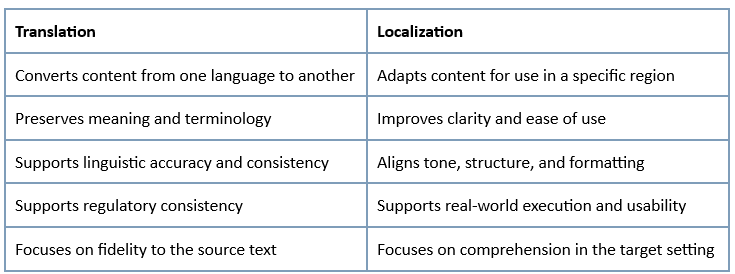
What Translation Does
The core focus of translation is balancing accuracy to the original text with natural flow in the target language. In clinical research, translation requires a high level of precision because clinical study materials such as informed consent forms, patient-facing instructions, and site documentation must retain their clinical intent exactly as written.
Strong translation focuses on accuracy, terminology consistency, and regulatory alignment, supported by tools and controls such as glossaries, translation memory, and structured review workflows. It provides a reliable linguistic foundation, but it does not ensure that materials will be easy to understand or use in every setting.
What Localization Adds to Clinical Trial Materials
Localization builds on translation by focusing on how content is experienced in context. It considers how translated materials will be read, understood, and used by participants and site teams in a specific region.
A direct translation may be technically correct but still feel unfamiliar. Sentence flow, tone, and the order of key details vary by region, affecting how easily content can be followed. In practice, the difference often becomes clear when site staff need to explain translated materials that were intended to stand on their own.
Localization also plays a key role in usability and health literacy. Participants rely on study content to understand expectations, risks, and procedures, while site staff use it to support consistent communication. When structure or phrasing does not align with local expectations, content becomes harder to use as intended.
Clinical trial materials are not just read; they are used to make decisions, follow instructions, and support participation. The World Health Organization notes that many people, even in economically advanced countries, have limited health literacy skills, underscoring the need for clear, accessible study content in global trials.¹ When translated content is not adapted for clarity, comprehension can decline further.
This emphasis on usability also aligns with FDA guidance stating that information provided to the subject or the representative must be in a language understandable to the subject or the representative.²
Localization also accounts for format, layout, and functional differences, including date formatting, units of measurement, numeric and currency formats, and widely varying punctuation and spacing rules. When these elements are misaligned, materials may be less understandable and used less consistently across sites, affecting both efficiency and clarity.
When to Use Translation, Localization, or Both
Regulatory and protocol-related documents often require precise translation to preserve clinical meaning, terminology consistency, and regulatory intent. Participant-facing materials may require localization in addition to translation to support comprehension and usability.
Use localization when content must be quickly understood, easy to follow, and natural for a specific regional audience. This is especially important for participant-facing content such as recruitment materials, reminders, diaries, digital study tools, and visit instructions where tone, format, and usability affect how well the content supports participation and site execution.
Patient population needs can also influence localization decisions.  In pediatric clinical trials, comic books, activity books, and visually guided trial maps may support engagement, but they must be adapted for local language, cultural context, and age-appropriate use.
For older populations, complex terminology, small text formats, and unfamiliar phrasing can create barriers to comprehension. Clear, readable, familiar language helps support informed consent and sustained participation.
Why the Distinction Matters in Clinical Trials
For participants, unfamiliar phrasing or structure can make study content harder to follow, reducing understanding and increasing the need for additional explanation. These challenges are often amplified across different patient populations, where usability and comprehension needs vary significantly. For study site staff, poorly localized content can create extra clarification work, introduce variation in how key information is communicated, and add friction to everyday workflows.
For sponsors and CROs, the issue is not simply whether content has been translated accurately. The more important question is whether it will work as intended in the region where it is being used. If it does not, the result can be less consistent participant understanding, greater site burden, and avoidable execution challenges across countries and study teams.
In global trials, the operational impact matters. Clear, regionally appropriate content supports more consistent communication, smoother site execution, and a better experience for both participants and study teams.
The Imperial Advantage
At Imperial Clinical Research Services, we help sponsors and CROs plan multilingual study materials with execution in mind, so content is translated accurately, adapted appropriately, and ready for participants, sites, and real-world study conditions.
Imperial’s subject matter experts also plan ahead when designing clinical trial materials to accommodate the typical text expansion or contraction. We also understand the nuances of laying out languages with right-to-left orientation.
Contact Imperial to discuss how we can support translation and localization for your next clinical study.
Frequently Asked Questions
What is the difference between translation and localization in clinical trials?
Translation converts content from one language to another while preserving its original meaning. Localization adapts that content for a specific region, including tone, structure, format, and ease of use.
When is localization necessary in a clinical trial?
Localization is most important for participant-facing materials and content that needs to be understood quickly and used correctly. It helps materials feel natural, culturally appropriate, and effective in real-world study settings.
Can translation alone be sufficient for clinical trial materials?
Yes, translation is sufficient for highly technical or regulatory content where precision and consistency are the primary priorities. However, it may not ensure that materials are easily understood or usable across different regions.
Why does localization matter for patient understanding and engagement?
Localization improves clarity and relevance by aligning materials with how participants interpret and process information. This helps reduce confusion, supports informed consent, and minimizes the need for additional explanation at the site level.
Do clinical trials need both translation and localization?
In many global studies, yes. Translation provides linguistic accuracy and consistency. Localization helps ensure participant-facing and site-facing materials are understandable, appropriate, and practical across regions. Together, they support both compliance and consistent study execution.
References
- World Health Organization. Health literacy. https://www.who.int/news-room/fact-sheets/detail/health-literacy
- U.S. Food and Drug Administration. Informed Consent Guidance for IRBs, Clinical Investigators, and Sponsors. August 2023. https://www.fda.gov/media/88915/download