


Risk management in clinical trials depends on systems that detect issues, correct them, and prevent them from returning. Corrective and Preventive Actions (CAPAs) are the structured process used to investigate deviations, address root causes, and strengthen controls. When CAPAs work, they protect study integrity and reduce recurrence. When they don’t, problems repeat and become more disruptive over time.
This article explains why CAPAs fail, what makes them effective, and how teams can build CAPA practices that improve quality rather than generate paperwork. The focus is on practical, system‑level habits that support reliable operations in a regulated environment.
In clinical research, quality relies on a system of habits, controls, and decisions that determine whether studies run smoothly or struggle. Corrective and Preventive Actions (CAPAs) are designed to be the corrective force within that system to protect trial integrity, strengthen compliance, and prevent recurrence. Regulators expect them, sponsors scrutinize them, and quality teams manage them.
Every regulated organization has a CAPA process, but not every organization has CAPAs that work, and too often, risk management in clinical trials through effective CAPA practice becomes an administrative exercise rather than a strategic tool.
CAPAs fail when they are designed to fix symptoms instead of systems. When that happens, problems return, and they are often more disruptive and more costly than before. In this blog, we explore what makes a CAPA truly effective and how to build a process that actually works as intended.
Why do CAPAs fail in clinical trials?
Most CAPA failures don’t begin with a lack of care or poor judgment; they begin with pressure. When a deviation occurs (a departure from an approved process), a response is needed, and in the clinical trials industry, the instinct is to act quickly.
Often, after correcting the immediate issue, the team breathes a sigh of relief. They close the file and move on. However, beneath that surface correction, the system remains unchanged. Common patterns appear across the industry:
- Root cause analysis stops at the first obvious answer.
- The investigation frequently involves the wrong mix of people.
- Teams implement corrective actions but fail to verify their effectiveness.
- They don’t fully assess the risk of recurrence.
- The effort invested does not align with the level of risk.
- Teams prematurely close CAPAs once the visible issue disappears.
Sometimes there is a simple reality to consider: not all problems can be prevented entirely. In some cases, the most realistic and responsible approach is to make failures more visible, faster, and easier to detect.
A CAPA that promises “zero recurrence” without changing system controls is not robust. It’s optimistic. Regulators, including MHRA and FDA inspectors, look beyond whether a CAPA exists and focus on whether it works. GDP guidelines and ISO quality principles reinforce the same expectation: identify root cause, implement proportionate controls, and verify effectiveness. A closed CAPA is not the goal. A controlled system is.
What is the real root cause of CAPA failure?
The phrase “human error” is rarely a root cause. It is usually the starting point. When investigations stop at individual action, they miss the system conditions that made that action possible.
- Was the procedure ambiguous?
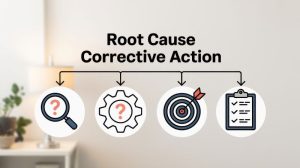
- Was the workload unrealistic?
- Was training reinforced or assumed?
- Were controls sufficient for the level of risk?
Root cause analysis requires the right voices in the room. Quality alone cannot solve operational gaps. Operations alone cannot assess regulatory risk. Effective CAPA teams bring a cross-functional perspective to the table. The goal is not to assign blame. It is to understand how the system allowed the deviation to occur.
In our experience, removing names from investigations changes the tone of the conversation. When people are not defending themselves, they are more willing to explore what truly happened. This shift transforms risk management in clinical trials, allowing effective CAPA to evolve from a reactive requirement into a proactive tool.
How should CAPA actions be proportionate to risk?
Not every deviation warrants a complex, multi-layered CAPA plan. And not every CAPA should be lightweight. The level of effort should be proportionate to the level of risk.
A documentation formatting issue does not require the same structural overhaul as a temperature excursion affecting investigational product integrity. Over-engineering low-risk CAPAs wastes resources. Under-engineering high-risk CAPAs invites recurrence.
A risk-based approach aligns with regulatory expectations and good quality practice. It ensures that teams invest energy where it matters most and apply controls where they will have a measurable impact. The question is not “Have we done something?” It is “Have we done enough?”
Corrective vs. Preventive: Both Matter
Corrective actions address what went wrong, while preventive actions focus on what could go wrong next. Organizations often implement strong corrective actions but fall short on effective preventive thinking. Although they address the deviation, the broader system risks remain unmitigated. Effective prevention can involve:
- Redesigning a process
- Strengthening training programs
- Adding automation or alerts
Sometimes, it’s about acknowledging that we cannot eliminate human variability and instead enhancing our detection mechanisms. True prevention is not about eradicating all risk; it’s about reducing the likelihood of issues, increasing visibility, and controlling their impact.
How should CAPA effectiveness be verified?
One of the most frequent weaknesses in CAPA systems is failure to verify effectiveness.
Once an action is implemented, the burning issue is no longer burning, and the CAPA is closed. But was the action effective?
Verification requires defined metrics, follow-up review, and a willingness to reopen discussions if recurrence occurs. Without this step, a CAPA becomes documentation instead of a control that prevents recurrence.
Closing the loop means confirming that the system behaves differently after the intervention. Our clients and our regulators would agree: anything less is an assumption.
Culture: From Blame to Prediction
A CAPA process should always focus on improvement rather than discipline. When individuals feel that it’s a tool for punishment, they are less likely to report issues, become defensive, and the root causes of problems can stay hidden. A mature CAPA system operates differently:
- It treats deviations as data
- It uses investigations to capture opportunities for improvement
- It recognizes that systems, not people, require strengthening
In our approach, the CAPA and deviation processes are mechanisms to predict the future. By analyzing trends and understanding patterns, we reduce recurrence and build resilience into operations.
Consider it space for learning, not blame. When teams trust the process, they engage more openly. When they engage openly, they deepen their investigations. As investigations deepen, recurrence drops. This is how CAPAs transform from reactive paperwork into proactive control.
CAPA Effectiveness Checklist
A CAPA should only be closed when the evidence supports it. Before closing a CAPA, ask:
- Have we identified the true root cause, not just the visible symptom?
- Were the right cross-functional stakeholders involved?
- Is the level of action proportionate to the level of risk?
- Have we considered the likelihood of recurrence?
- If we cannot eliminate recurrence, have we improved visibility?
- Have we defined and completed effectiveness verification?
- Are we confident that the system now behaves differently?
If you find uncertainty in any of these areas, the loop may not yet be closed. That uncertainty signals you to pause, reassess, and strengthen the control.
Final Thoughts
When corrective and preventive actions are rooted in real analysis, proportionate risk management, and verified effectiveness, they do more than resolve deviations. They build trust with sponsors, regulators, and internal teams alike. The most effective CAPA processes do not simply react to the past. They shape the future. And in a regulated environment, that future depends on systems that learn.
Key Takeaways
Effective CAPA practice strengthens risk management by identifying true root causes, not just correcting visible symptoms.
- CAPAs fail when teams rush through them, investigations stop early, or they overlook system conditions.
- Proportionate, risk‑based actions prevent recurrence more reliably than over‑ or under‑engineered responses.
- Verification of effectiveness is essential; a CAPA is only complete when the system behaves differently.
- A mature CAPA culture treats deviations as data, supports open investigation, and builds long‑term operational resilience.
More!
This blog is the third in our risk management in clinical research series. You can explore the foundation of this important topic in our first installment, Front Line of Clinical Trial Risk Management: The Internal Audit, and more in our second installment, Strategies for Risk Mitigation to Prevent Deviations in Clinical Trials.
Frequently Asked Questions
What makes a CAPA effective?
An effective CAPA addresses the true root cause, applies proportionate controls, and demonstrates verified changes in system behavior.
How do regulators evaluate CAPA effectiveness?
Regulators assess whether root cause analysis was sufficient, actions were risk‑based, and effectiveness was verified over time.
Can CAPAs completely prevent recurrence?
Not always. Effective CAPAs reduce the likelihood, increase visibility, and control impact rather than promising zero recurrence.