Imperial Recognized as 2026 National Best and Brightest Company to Work For! Learn More

Imperial Clinical Research Services Blog
  • Services
    • What We Do
    • Study and Site Print Materials
    • Clinical Trial Translation Management
    • Ancillary Trial Supplies and Equipment
    • Clinical Trial Patient Engagement
    • CRO-Centered Services
    • A La Carte Services
  • Resources
    • Ebooks
    • Case Studies & Fact Sheets
  • About
    • About Us
    • News
    • Events
    • Corporate Responsibility
  • Contact
    • Contact Imperial
    • Career Opportunities
  • Blog
  • Marketplace
  • Services
    • What We Do
    • Study and Site Print Materials
    • Clinical Trial Translation Management
    • Ancillary Trial Supplies and Equipment
    • Clinical Trial Patient Engagement
    • CRO-Centered Services
    • A La Carte Services
  • Resources
    • Ebooks
    • Case Studies & Fact Sheets
  • About
    • About Us
    • News
    • Events
    • Corporate Responsibility
  • Contact
    • Contact Imperial
    • Career Opportunities
  • Blog
  • Marketplace
Category:

Translation of Clinical Trial Materials

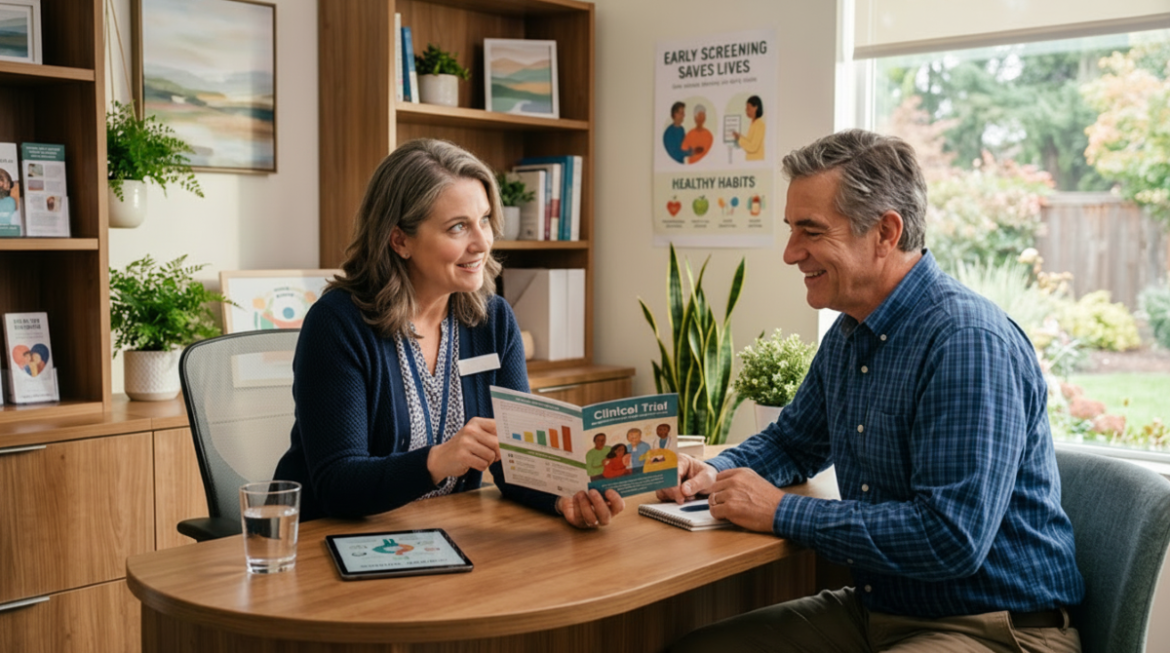
    Clinical study team member showing participant a clinical trial booklet
    Clinical Trial Materials Development and PrintingParticipant EngagementTranslation of Clinical Trial Materials

    3 Steps to Create User-Friendly Participant Materials

    by Marta Korgol September 9, 2026
    written by Marta Korgol

    Quick Summary

    Participant materials play an important role throughout the clinical trial experience, but usability can be compromised during development and review cycles. As information is added and revised, documents often become longer, more complicated, harder to navigate, and exceed desired specs. Creating user-friendly materials requires more than accurate content. It requires attention from all contributors to readability, the information included, and how easily participants can find what they need. This article explores practical ways to evaluate participant materials and ensure they support participants at every stage of the clinical trial.

    ___________________________________

    Making Clinical Trial Participant Materials Easy to Use

    Participants navigate their clinical trial experience through a variety of means. This includes contact with study teams, information from participant materials, and directions from apps.

    Considerable effort goes into developing participant materials. Contributors include study teams and medical reviewers, as well as the legal department. With honorable intentions, different people add, revise, update, add some more, and revise again. Each document, with its thoroughness and accuracy, is something to be proud of.

    But when the dust has settled, the result must be put to the test: are the materials user-friendly?

    Every piece we hand to a participant should pass the user-friendly test. Yes, that seems obvious, but it doesn’t always happen. Sometimes, the participant’s experience becomes a secondary consideration. Participant materials must be complete and accurate, but those goals should not come at the expense of usability.

    So, what does the user-friendly test actually involve? Here are elements to consider:

    1. Readability

    Materials should be written and reviewed with health literacy in mind. The National Institutes of Health recommends aiming for a sixth-grade reading level, which is reasonable for user-friendly participant materials. But don’t go so far in refining your word choices that you’ve removed the precision of the language. Some words may increase the reading level score. But simpler alternatives don’t always preserve the meaning. For example, it’s important to provide the reader with the actual names of tests and procedures. Terms like “heart test” instead of ECG or “health check” instead of physical exam may improve a readability score, but they aren’t precise and can create confusion for participants. A better approach is to introduce clinical terms alongside a plain-language explanation the first time they appear, then use the same terminology consistently throughout the study materials.

    Another important factor is maintaining consistent terminology. Changing terminology can create confusion. If a study period is called a “treatment period” in one document, it should not suddenly become a “study drug use period” in another. Participants should not have to wonder whether two different terms describe the same thing.

    Consistent language helps participants build familiarity with study concepts and reduces the effort required to understand new documents. Before introducing a new term, consider whether an existing term already communicates the idea clearly. While the differences may seem minor to clinical trial teams, they can create unnecessary confusion for participants.

    Readability is about more than reading level and terminology. Information should be presented in a way that is easy to absorb:

        • One idea at a time
        • Use bullet lists when appropriate
        • Avoid long sentences
        • Avoid long paragraphs, which create dense blocks of text

    The goal is to make the information easier to scan, understand, and use without weakening the accuracy of the content.

    2. The Information Included

    Every participant document should have a specific purpose and stay true to that purpose. Before adding information to a document, it’s worth asking yourself whether it belongs. This consideration is important during writing and can become even more critical during revisions, where more information is often added to make materials appear more complete. Over multiple rounds, documents can begin to accumulate information that does not support their primary purpose.

    Recruitment materials, such as brochures, should include eligibility criteria and mention the informed consent process. However, brochures are not visit guides. If the text tries to include too much, for example providing specific visit information, its usefulness is compromised.

    A visit guide’s purpose is to help participants prepare for visits and navigate study activities. It’s not a consent document. Yet eligibility criteria and informed consent information can still creep in unnecessarily. Yes, those elements of a clinical trial are important, but the participant using the visit guide has already encountered that information elsewhere and even gone through the process.

    Every piece of information and every addition should help participants understand or prepare for something. If it doesn’t, it may make the material harder to use by lengthening it, making it harder to navigate, and reducing its usefulness. More information is not always an improvement.

    3. Organization, Navigation, and Design

    A user-friendly document is not just about the information it contains. It’s also about how easily the information can be found. A participant may return to a document multiple times throughout a clinical trial. Rarely do they read it from beginning to end. They are usually looking for a specific answer.

    Finding those answers shouldn’t require searching through pages of text. The goal is to help participants find the information they need when they need it.

        • Contact information can be the most important information participants receive. Whether it appears in a brochure, guide, website, portal, or app, it should be easy to locate.
        • Clear section headers help readers navigate. Participants frequently return to materials looking for one specific answer. Clear section headers help them locate relevant information rather than searching through large sections of text.
        • Visual cues like color coding, callout boxes, icons, typography, and thoughtful use of white space can help important information stand out and make materials easier to navigate.
        • A table of contents is not suitable for every document, but it is essential for guides and handbooks.

    Materials intended for global studies should also be designed with translation and localization in mind. Text may expand significantly in some languages, affecting layouts, page flow, and available space in tables, diagrams, and other design elements. Planning for these differences early can help maintain readability and usability across languages and regions.

    User-Friendly Participant Materials Checklist

    Taking a few minutes to review materials from the participant’s perspective can help identify issues before they become sources of confusion.

    Ask the following questions:

    • Does this sentence or paragraph belong in this piece?
    • Is this helping the reader accomplish something?
    • Can the information be found easily?
    • Is the reading level appropriate?
    • Is the terminology consistent across materials?
    • Does this piece support the document’s mission and reflect where the reader is in their clinical trial journey?

    Last Thoughts

    A user-friendly document is not necessarily the document that contains the most information. It’s the document that supports its intended purpose.

    A participant may never notice the effort that went into creating a document. What they do notice is whether they can easily understand what they’re reading and whether they can find the information they need when they need it.

    When teams apply these principles, the value extends well beyond a cleaner document. Participants are more likely to understand what is expected, find answers quickly, and move through study activities with greater confidence. Study teams can benefit from fewer repeated questions, clearer communication, and materials that better support recruitment, retention, and compliance. User-friendly participant materials can help create a more consistent, participant-centered clinical trial experience while reducing avoidable confusion for the people the study depends on most.

    The Imperial Advantage

    At Imperial, we start by defining the essential purpose of each material, creating each one to serve that role while always putting the participant’s experience first. Our award-winning creative team understands how literacy, design, and translation are vital components that help shape the participant’s experience. That’s how we turn digital and print clinical trial materials into tools that connect.


    Sign Up For Imperial Blog Alerts
    Contact Us
    September 9, 2026 0 comments
    0 FacebookTwitterLinkedinEmail
  • Clinical Trial Business InsightsClinical Trial Materials Development and PrintingTranslation of Clinical Trial Materials

    How Version Control in Clinical Trial Materials Reduces Risk

    by Heather Ross August 26, 2026
    by Heather Ross August 26, 2026

    Quick Summary Version control in clinical trial materials protects research communications from outdated or incorrect content as workflows become more complex. As study materials move through writing, design, regulatory review, translation, printing, publishing, and distribution, even a small source change can affect every downstream asset. …

    0 FacebookTwitterLinkedinEmail
  • Clinical Trial Business InsightsParticipant EngagementTranslation of Clinical Trial Materials

    Translation vs. Localization in Clinical Trials: Why the Difference Matters

    by Sian Lukaszewicz July 15, 2026
    by Sian Lukaszewicz July 15, 2026

    Quick Summary Translation converts clinical trial content from one language to another while preserving meaning, terminology, and regulatory intent. Localization adapts translated content to ensure it is understandable, practical, and appropriate for the region where participants and site teams will use it. In global clinical …

    0 FacebookTwitterLinkedinEmail
  • Participant EngagementTranslation of Clinical Trial Materials

    The Power of Video in Clinical Trials: A Strategic Asset for Sponsors and CROs

    by Vaughn X. Anthony November 18, 2025
    by Vaughn X. Anthony November 18, 2025

    At the heart of every clinical trial are the people who choose to participate. They need reassurance, confidence, and trust in the process and in the research staff guiding them. Using video in clinical trials has the unique ability to meet those needs while also …

    0 FacebookTwitterLinkedinEmail
  • Ancillary Clinical Trial Supplies and EquipmentClinical Trial Business InsightsClinical Trial Materials Development and PrintingTranslation of Clinical Trial Materials

    How Can You Boost Clinical Trial Management Efficiency When Working with Vendors?

    by Dan McDonald February 26, 2025
    by Dan McDonald February 26, 2025

    Discover how to boost clinical trial management efficiency and minimize pain points for your next clinical study. The Complex Landscape of Clinical Studies The management hours required to oversee the many components of a clinical trial are substantial. Clinical operations teams typically concentrate on several …

    0 FacebookTwitterLinkedinEmail
  • Clinical Trial Materials Development and PrintingParticipant EngagementTranslation of Clinical Trial Materials

    Clinical Research Translation: Can You Manage all the Moving Parts?

    by Heather Ross May 2, 2024
    by Heather Ross May 2, 2024

    Clinical research translation affects almost every global study. Understanding the translation process and the planning required can help keep your study on track. Clinical trial statistics can be surprising. We frequently write about different aspects of the growing complexity of global clinical trials. Despite the …

    0 FacebookTwitterLinkedinEmail
  • Translation of Clinical Trial Materials

    Clinical Trial Translation: Precision Is Key

    by Erica Manning May 9, 2023
    by Erica Manning May 9, 2023

    Accurate clinical trial translation services are key to the overall success of a study. Each participant needs to receive the same information in their native language to ensure consistent study messaging across all languages and accuracy to the protocol. I’ve compiled key translation best practices …

    0 FacebookTwitterLinkedinEmail
  • Ancillary Clinical Trial Supplies and EquipmentClinical Trial Business InsightsClinical Trial Materials Development and PrintingParticipant EngagementTranslation of Clinical Trial Materials

    Clinical Trial Efficiencies: The Power of a Single Workstream

    by Dan McDonald August 18, 2022
    by Dan McDonald August 18, 2022

    The management time needed to corral many different elements during a trial is immense. In the buildup to a research study, clinical operations teams often focus on items such as study startup, site initiation and activation, supply chain, monitoring, data management, and safety. And there …

    1 FacebookTwitterLinkedinEmail
  • Translation of Clinical Trial Materials

    Machine Translation: OK for Your Clinical Trial Materials?

    by Sian Lukaszewicz February 15, 2022
    by Sian Lukaszewicz February 15, 2022

    The number of global trials grows every year, with study teams reaching out to increasingly diverse patient populations. These broader populations bring a growing variety of languages, cultures, and experiences – all of which need to be considered when recruiting or interacting with clinical trial …

    0 FacebookTwitterLinkedinEmail
  • Translation of Clinical Trial Materials

    Translations for Clinical Trials: COVID-19 Brings Special Challenges

    by Sian Lukaszewicz September 30, 2021
    by Sian Lukaszewicz September 30, 2021

    Translations for Clinical Trials: COVID-19 Brings Special Challenges

    1 FacebookTwitterLinkedinEmail
  • 1
  • 2
  • 3

Signup for our Blog Subscription

Signup for our Blog Subscription

Keep in touch

Twitter Linkedin Youtube Email Rss

Popular Posts

  • 1

    Clinical Research Phases and the Path to Drug Approval

    August 8, 2023
  • 2

    See Do Get

    August 12, 2014
  • 3

    Google Translate: The Unwitting Confidentiality Flaw

    April 15, 2020
  • 4

    25 Reasons People Aren’t Enrolling in Your Clinical Trial

    October 29, 2015
  • 5

    The Upcoming FDA Clinical Trial Diversity Mandate: What You Need to Know

    May 14, 2025

Categories

  • Ancillary Clinical Trial Supplies and Equipment (40)
  • Clinical Trial Business Insights (196)
  • Clinical Trial Materials Development and Printing (53)
  • Participant Engagement (113)
  • Translation of Clinical Trial Materials (21)
Imperial Clinical Research Services Blog

Imperial is a global leader in clinical trial solutions and support, specializing in study and site print materials, ancillary trial supplies and equipment, clinical trial translation management, and clinical trial patient engagement.

Imperial CRS Corporate Headquarters
3100 Walkent Drive NW
Grand Rapids, MI 49544

Contact

connect@imperialcrs.com

800.777.2591

020 3887 3437

Employment

Social

We Run on EOS - Entrepreneurial Operating SystemEcovadis Sustainability Rating January 2024West Michigan's Best and Brightest Companies to Work For Winner 2025The Best and Brightest Companies to Work For Logo
© Imperial CRS, LLC | Privacy Policy
Signup for our Blog Subscription

Subscribe to our blog and get the latest updates, insights, and industry trends delivered straight to your inbox. Stay informed and never miss a post.


Imperial Clinical Research Services Blog
  • Home
    • Home #1
      • Infinite Scroll Load More
      • Infinite Load More Posts
      • Home Featured Video
      • Body Boxed Image
      • Body Boxed Color
      • Home with Left Sidebar
      • Home with Sticky Sidebar
      • Standard Layout
      • Classic Layout
    • Home #2
      • Grid Layout
      • Grid with Sidebar
      • Grid 2 Columns Layout
      • List Layout
      • Masonry Layout
      • Masonry with Sidebar
      • Masonry 2 Columns Layout
      • Boxed Layout
      • Overlay Layout
    • Home #3
      • Mixed Layout
      • Mixed Style 2 Layout
      • Photography Layout
      • Magazine Layout 1
      • Magazine Layout 2
      • Magazine Layout 3
      • 1st Overlay Then Grid
      • 1st Overlay Then List
      • 1st Standard Then Grid
    • Home #4
      • 1st Standard Grid Sidebar
      • 1st Standard Then Grid 2
      • 1st Standard Then List
      • 1st Standard Then Boxed
      • 1st Classic Then Grid
      • 1st Classic Grid Sidebar
      • 1st Classic Then Grid 2
      • 1st Classic Then List
      • 1st Classic Then Boxed
  • Destinations
  • Travel Tips
  • Sliders
    • Slider #1
      • Home with Slider 1
      • Home with Slider 2
      • Home with Slider 3
      • Home with Slider 4
      • Home with Slider 5
      • Home with Slider 6
      • Home with Slider 7
      • Home with Slider 8
    • Slider #2
      • Home with Slider 9
      • Home with Slider 10
      • Home with Slider 11
      • Home with Slider 12
      • Home with Slider 13
      • Home with Slider 14
      • Home with Slider 15
      • Home with Slider 16
    • Slider #3
      • Home with Slider 17
      • Home with Slider 18
      • Home with Slider 19
      • Home with Slider 20
      • Home with Slider 21
      • Home with Slider 22
      • Home with Slider 23
      • Home with Slider 24
    • Slider #4
      • Home with Slider 25
      • Home with Slider 26
      • Home with Slider 27
      • Home with Slider 28
      • Home with Slider 29
      • Home with Slider 30
      • Home Penci Slider 1
      • Home Penci Slider 2
  • Features
    • Headers
      • Header Style 1
      • Header Style 2
      • Header Style 3
      • Header Style 4 (Centerd)
      • Header Style 5 (Centerd)
      • Header Style 6
      • Header Style 7
      • Header Style 8
      • Header Style 9
    • Menu Item Style 1
    • Real Awesome Gallery
    • Standard Post
      • Standard Full Width
      • Style 2
      • Style 2 Sidebar Left
      • Standard Sidebar Right
    • Gallery Post
      • Gallery Full Width
      • Style 2
      • Style 2 Left Sidebar
      • Gallery Sidebar Right
    • Video Post
      • Youtube Post
      • Vimeo Post
      • Video Full Width
      • Style 2
      • Style 2 Sidebar Left
      • Video Sidebar Right
    • Audio Post
      • Soundcloud Audio
      • Self-hosted Audio
      • Audio Full Width
      • Style 2
      • Style 2 Sidebar Left
      • Audio Sidebar Right
    • Quote Post
      • Quote Full Width
      • Style 2
      • Style 2 Sidebar Left
      • Quote Sidebar Right
    • Link Post
      • Link Full Width
      • Style 2
      • Style 2 Sidebar Left
      • Link Sidebar Right
    • Pages
      • About me
      • Contact Me
      • Page Left Sidebar
      • Page Full Width
      • Page 404
    • Typography
  • Portfolio
    • Masonry 3 Columns
    • Masonry 2 Columns
    • Masonry with Sidebar
    • Grid 3 Columns
    • Grid with Sidebar
    • Grid 2 Columns
    • Single Portfolio
  • Shop