

Quick Summary
Having a strategy for vendor consolidation in clinical trials matters because the components of clinical trial execution are highly interdependent. When too many vendors are involved, handoffs, version control issues, and coordination gaps can slow timelines and increase internal coordination burden.
Consolidating vendors delivers the most value when it creates true operational integration across services like study materials, translation, printing, kitting, and logistics. That integrated model improves accountability, reduces the need for rework, and allows sponsors and CROs to manage protocol changes and global execution more efficiently.
___________________________________________________
Why Vendor Strategy Matters More Than It Appears
Sponsors and CROs often depend on multiple vendors working across different parts of their studies. On paper, separate vendors can look manageable. In practice, every handoff creates another point where timing, ownership, and version control can drift, leading to delays, rework, and misalignment across teams.
Vendor consolidation in clinical trials is often used to address this by reducing the number of providers involved. It makes a difference because study materials, printing, translation, supplies, and logistics are tightly linked in execution. A more integrated approach helps protect timelines, reduce rework, and improve accountability, especially when workstreams need to stay aligned across development, translation, production, distribution, and change control.
Key Benefits of Vendor Consolidation
- Faster execution: Fewer handoffs help related deliverables move more quickly from development to implementation.
- Clearer accountability: One coordinated model improves ownership, visibility, and decision-making across coordinated services.
- Less internal burden: Study teams spend less time managing vendor alignment and more time on critical trial priorities.
- Synchronized execution: Integrated planning helps coordinated workstreams stay aligned across countries and sites.
- Stronger commercial leverage: Consolidated spend may improve pricing, rebate opportunities, and administrative efficiency.
What Vendor Consolidation Really Means in Clinical Trials
Vendor consolidation in clinical trials means reducing the number of service providers involved in study execution and managing those activities through one operational model instead of multiple disconnected vendors.
From a sponsor or CRO perspective, that means fewer vendors to manage across interdependent trial support functions, with clearer ownership, fewer version-control issues, and less time spent coordinating disconnected providers. Vendor consolidation delivers the most value when it is backed by a truly integrated execution model.
Why Vendor Strategy Shapes Clinical Trial Execution
Clinical trial execution is tightly connected. A change in one area often triggers updates across related materials, localization, production, kitting, and distribution steps. In fragmented models, sponsors and CROs can end up acting as the link between vendors, spending time aligning approvals, timelines, and releases instead of moving the work forward. That added coordination burden can pull study teams away from other critical elements of clinical trial planning and execution, while the day-to-day effort of managing multiple vendors becomes exhausting and frustrating over the life of a study.
Integrated execution creates value before any amendment occurs by bringing coordinated workstreams together from the outset. Writing, design, translation, print production, ancillary planning, clinical trial kitting, and logistics can move on coordinated timelines, with print specifications, translation expansion, layout adaptation, and regional translation needs considered early rather than corrected later. That helps keep materials consistent, downstream steps ready when needed, and implementation more controlled as study requirements evolve.
What True Integration Looks Like in Practice
An integrated clinical trial support provider does more than offer a variety of services. It brings coordinated trial support activities together under one execution approach. This includes unified project leadership, coordinated change control, and shared visibility into key areas such as timelines, ownership, approvals, inventory, and shipment status.
For example, consider the development of multi-country, multi-language patient recruitment materials. In an integrated workstream, writers, designers, linguists, production teams, and project leads work from a shared timeline and a connected communication path. Writers can develop source content with translation expansion in mind. Linguists can flag language-specific issues that may affect layout or formatting. Designers and production teams can plan for text expansion before materials reach final proofing. Because the work is coordinated through one model, adjustments can be made quickly, processes stay consistent, and each team understands when the work will reach its desk.
In a decentralized model, the same work can become fragmented. Source materials may be completed and passed to a translation vendor that is not ready to receive them. File sharing may become complicated. Sponsors or CROs may need to coordinate communication between vendors. Translated content may return longer than expected and no longer fit the approved design framework. When corrections are needed, teams can lose time determining which vendor owns the issue instead of resolving it quickly.
In practice: Integrated execution gives cross-functional teams shared visibility before work moves downstream; fragmented execution often forces sponsors and CROs to reconnect timelines, files, decisions, and corrections after problems surface.
The Hidden Cost of Fragmentation Becomes an Execution Problem
Every Handoff Creates Another Opportunity for Failure
Each handoff creates another opportunity for delays, version mismatches, and release errors. When files, approvals, inventory, and shipment timing are managed across separate vendors, small gaps can turn into operational disruption.
The Real Cost Shows Up in Coordination Burden

- Study teams spend time reconciling approvals and release timing across vendors
- File versions and translated materials can fall out of sync across regions
- Inventory decisions are slowed when supply status is split across separate systems
- Regional rollout becomes uneven when updates are released on different timelines
The result is more hidden labor for internal and regional teams, who end up chasing status, correcting inconsistencies, and absorbing work that should have been built into the execution model.
The real burden often shows up in the work no one planned for: follow-up emails, status checks, version comparisons, and last-minute coordination between teams that were never set up to operate as one workflow. That time cost can be significant: every hour spent coordinating across multiple vendors is time study teams cannot spend on other critical trial planning and execution priorities.
Change Magnifies the Risk of Fragmented Execution
When studies change midstream, fragmented vendor models make implementation harder. Updates must move through separate timelines, approval paths, and systems, increasing the chance that materials, translations, and supply plans will not advance together. A common example is when design, writing, translation, formatting, print production, and shipping are managed by different vendors: approved source content may move forward, but translated text can expand, no longer fit the intended layout, require reformatting, trigger another proof cycle, and delay print release and shipment.
A mid-study update that touches design, translation, and logistics can be approved once but implemented in stages, leaving some sites working from older materials while others receive newer versions.
Why Strategic Consolidation Creates Business Value
Clear Ownership Leads to Faster, Better Decisions
Consolidation simplifies ownership and reduces escalation across vendors. With one project lead coordinating connected activities, approvals and downstream decisions can move faster and with less confusion.
Fewer Handoffs Mean Faster Execution
When proofing, preproduction, and release move through one process, deliverables and updates spend less time delayed by cross-vendor alignment. That helps teams move approved work forward with less delay and rework.
Synchronized Clinical Study Execution Protects Global Rollout
As clinical trials extend across countries and regions, consolidation helps keep study materials, printing, translations, supplies, and shipments synchronized by centralizing planning, reducing regional variability, and making high-volume operations easier to manage.
Consolidated Spend Can Strengthen Pricing Leverage
Consolidated spend can create stronger pricing leverage. In the right model, greater volume may support discounts, rebate opportunities, and lower administrative overhead. These efficiencies are harder to capture when spend is fragmented across multiple vendors.
Protocol Amendments Expose the Cost of Fragmented Execution
Protocol Changes Are a Constant, Not an Exception
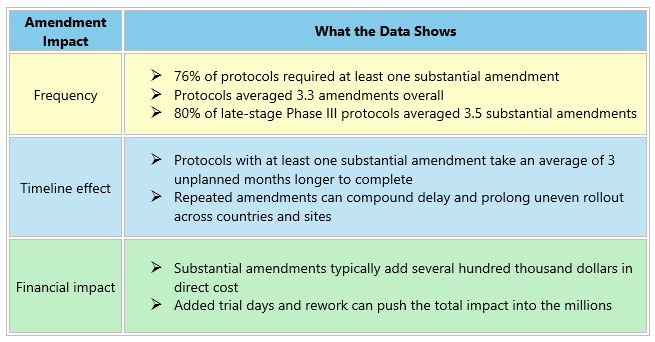
Amendments to the protocol are common across the clinical trial lifecycle and often affect multiple interdependent functions at once, from study materials and translation to supplies, kitting, and distribution. Recent Tufts CSDD benchmarks show that most protocols require at least one substantial amendment, with amendment frequency increasing in late-stage Phase III studies. 1
Protocol amendments create pressure in more than one way: they occur frequently, extend execution, and increase the financial burden on already complex studies.
How the Financial Impact Grows Beyond Direct Cost
The financial burden of protocol amendments is not limited to the direct cost of implementing the change itself. When amendments recur over the life of a study, they extend the period of cross-functional coordination, increase the likelihood of rework, and prolong the time in which countries and sites may be operating on different versions or timelines. That is why the broader impact can grow well beyond the initial amendment cost, particularly when fragmented execution makes synchronized implementation harder to achieve. 1,2
Regulatory Oversight Raises the Stakes of Every Amendment
FDA IND regulations require sponsors to submit protocol amendments for new protocols and significant protocol changes, and those studies or changes may proceed once they have been submitted to FDA and approved by the responsible IRB. 3
Fragmentation Makes Every Amendment Harder to Execute
When execution is split across multiple vendors, approved changes move through separate timelines, approval paths, and systems. That increases the risk that materials, translations, inventory plans, and shipments will not be updated at the same pace across sites and regions.
Consolidated Execution Strengthens Change Control
A consolidated model improves change control by moving updates through one timeline with clearer operational visibility. That makes implementation more consistent and reduces avoidable delay.
Warning Signs That Fragmentation Is Slowing Your Study
Fragmentation often creates warning signs before delays are visible at the site level. When the same issues recur, the problem is usually not a one-off execution error, but a coordination burden created by too many disconnected vendors. Common signs include:
- Approved materials or updates require repeated vendor alignment before release
- Materials, translations, and shipments follow different regional timelines
- Inventory status and shipment readiness cannot be confirmed in one reliable view
- Site rollout slows because approvals, proofing, and logistics are not advancing together
- Internal teams spend more time reconciling status than moving execution forward
What Sponsors Should Evaluate Before They Consolidate
When evaluating a clinical trial support model, sponsors should look beyond service breadth alone. The more important question is how work will be structured across interdependent functions, who owns coordination, and how changes will move from approval to implementation. In practice, that means evaluating whether the model provides clear accountability, supports change control, maintains operational visibility, and reduces the internal burden of managing multiple vendor handoffs—not just whether it expands service scope.
The right model also depends on study needs, service dependencies, and operational complexity. Some studies benefit from broader coordination across related functions, while others require a more focused scope in specific service areas such as printing, translation, ancillary supplies, or kitting. The key is not whether every service sits under one provider, but whether the operating model keeps execution aligned as studies evolve.
What an Integrated Model Can Look Like in Practice
Imperial Clinical Research Services supports this through a flexible execution model that can span multiple coordinated services or a more focused area of support, depending on study requirements. When broader coordination is needed, Imperial helps align study materials development, printing, translation, ancillary supplies, equipment, kitting, and logistics so related activities move forward on coordinated timelines rather than in isolation.
That integrated approach is designed to improve operational visibility, strengthen change control, and reduce friction where service dependencies can otherwise slow execution.
For sponsors and CROs evaluating the best-fit support model, Imperial can help determine where broader coordination may add value and where a more focused service scope may be more appropriate.
The goal is not consolidation for its own sake; it is a support model that makes coordinated work easier to manage when the study is already complex enough.
Key Takeaways
- Vendor consolidation reduces coordination burden by aligning interdependent services within a single operational model.
- Fragmented vendor structures increase execution risk, especially during protocol amendments and global rollout.
- The real cost of fragmentation often appears as hidden internal effort, delays, and inconsistent execution across regions.
- The value of consolidation depends on how well the model coordinates work across functions—not simply how many vendors are reduced.
Common Questions
What is vendor consolidation in clinical trials?
Vendor consolidation in clinical trials is the practice of reducing the number of service providers and managing interconnected activities through a coordinated operational model.
When does vendor consolidation make the biggest difference in a clinical trial?
Vendor consolidation tends to matter most when study materials, printing, translation, ancillary supplies, kitting, and logistics are closely connected. The more those elements need to move together across functions, countries, and sites, the more important integrated execution becomes.
Does every study need a fully consolidated support model?
No. Some studies need broad coordination across connected services, while others need focused support in specific areas. The better question is whether the operating model keeps related work aligned as the study evolves.
What are the early signs that a fragmented vendor model is creating risk?
Early signs include repeated vendor alignment before release, inconsistent timing across materials and shipments, limited visibility into inventory or logistics, and internal teams spending too much time reconciling status. These patterns suggest the operating model may be creating coordination risk, not just isolated task delays. For example, translated materials may need layout adjustments before printing, or kitting may be delayed because printed documentation and ancillary components are not ready at the same time.
Which clinical trial support services benefit most from vendor consolidation?
Highly interdependent functions benefit most. In clinical trials, that often includes study materials development, printing, translation, ancillary supplies, kitting, warehousing, and distribution. These functions benefit during both initial development and later changes, when writing, design, translation expansion, print specifications, and kitting timelines need to be planned together.
References
- Tufts Center for the Study of Drug Development (CSDD). Shining a Light on the Inefficiencies in Amendment Implementation. Applied Clinical Trials.
https://www.appliedclinicaltrialsonline.com/view/shining-a-light-on-the-inefficiencies-in-amendment-implementation - Getz K. Acknowledging Cycle Time Impact from Protocol Amendments. Applied Clinical Trials.
https://www.appliedclinicaltrialsonline.com/view/acknowledging-cycle-time-impact-protocol-amendments - U.S. Food and Drug Administration (FDA). 21 CFR 312.30 — Protocol Amendments. Electronic Code of Federal Regulations.
https://www.ecfr.gov/current/title-21/chapter-I/subchapter-D/part-312/subpart-B/section-312.30
