

Quick Summary
Clinical trial diversity is often discussed through the lens of race and ethnicity, but meaningful inclusion extends much further. Representation gaps persist across a wide range of populations, including women, older adults, people with disabilities, LGBTQ+ individuals, non-English speakers, and low-income communities.
Improving clinical trial diversity can strengthen recruitment, retention, patient safety, data quality, and overall study outcomes. Achieving these goals requires more than participant enrollment. It requires accessible materials, culturally relevant communication, community engagement, and participant-centered experiences throughout the clinical trial journey.
__________________________________________________________________
Why Meaningful Inclusion Goes Beyond Race and Ethnicity
When we hear the phrase clinical trial diversity, most people immediately think of race and ethnicity. That’s understandable. These conversations are important, and long-standing disparities in research participation still need to be addressed.
The industry has made meaningful progress in recent years, with greater awareness, increased focus on representation, and stronger efforts to engage historically underrepresented populations. But after more than 20 years in the clinical trial industry, I’ve come to believe that the definition of diversity is often too narrow. Advancing clinical trial diversity requires looking beyond traditional demographic categories and considering the many factors that influence participation, engagement, and outcomes.
When we broaden our understanding of diversity, we move beyond race alone and begin to consider sex, gender, age, disability, language, geography, socioeconomic status, and cultural background. More importantly, we begin to create research experiences where participants feel seen, respected, and supported throughout their clinical trial journey. That’s where meaningful inclusion begins.
Diversity Isn’t One-Dimensional
Despite years of discussion around diversity in clinical research, significant representation gaps remain. Many clinical trial populations still do not reflect the real-world patients that therapies are intended to serve, which can affect the quality, applicability, and reliability of clinical trial data.
The table below shows how underrepresentation appears across different patient populations and the barriers that can limit participation.
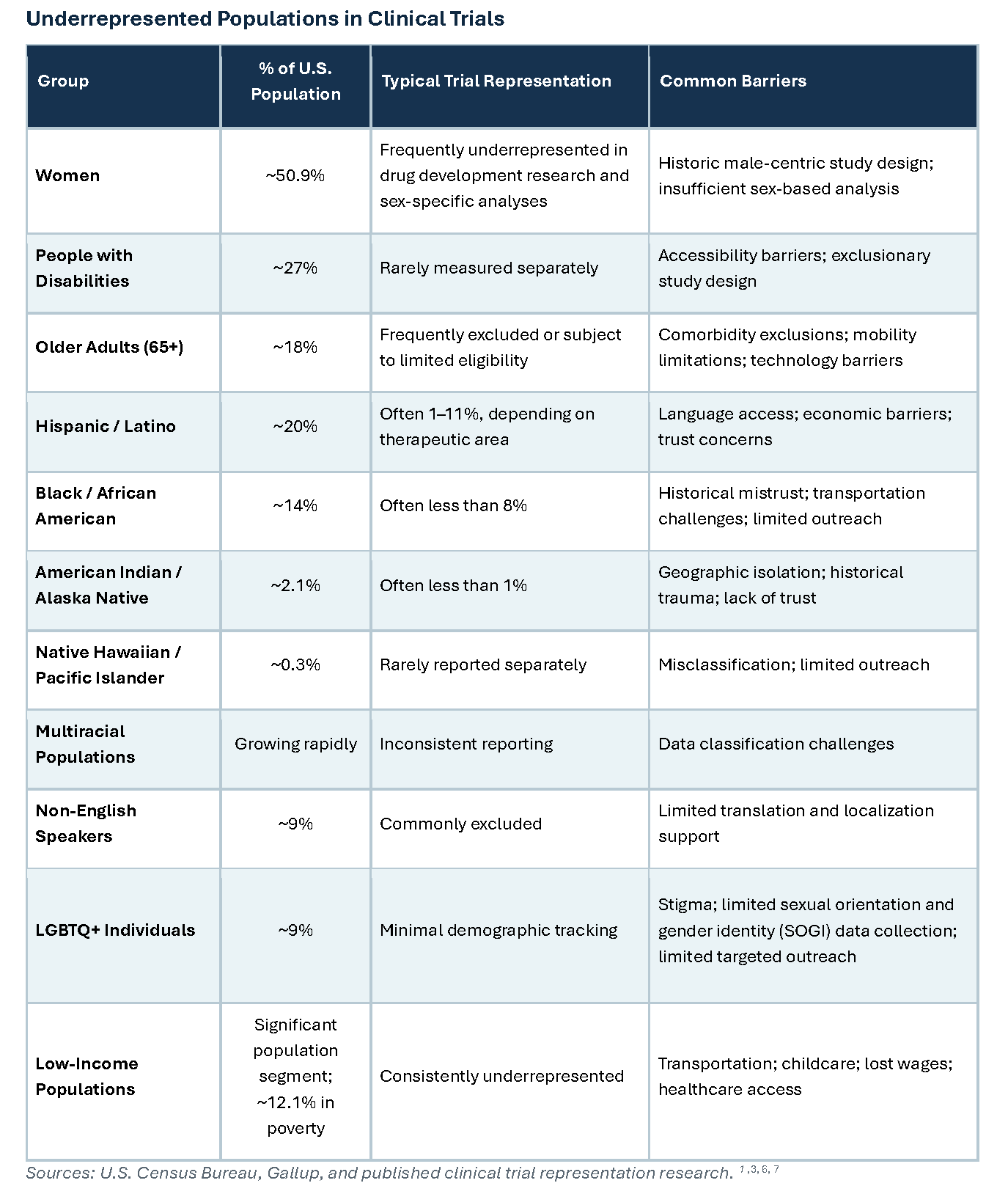
The table underscores a broader point: clinical trial diversity is not limited to race and ethnicity. Representation gaps across age, sex, language, disability, geography, and socioeconomic status can influence participation, retention, treatment response, and the quality of clinical trial outcomes.
Several examples show how these representation gaps appear in practice.
LGBTQ+ Communities
Many clinical studies still collect limited information regarding sexual orientation and gender identity. Combined with concerns about stigma, privacy, and a lack of targeted outreach, this continues to create gaps in participation and understanding.3˒4
Older Adults
Adults over age 65 use more prescription medications than any other age group, yet they remain consistently underrepresented in clinical research.5 Eligibility restrictions, comorbidity concerns, and assumptions about treatment adherence often exclude the population most likely to benefit from the therapies being studied.
This lack of representation leads to critical gaps in understanding how drugs interact with age-related physiological changes, the appropriate dosages for older adults, and the effects of investigational medications when taken alongside common prescriptions used by older adults.
Sex-Based Differences in Clinical Research
Research has shown that 76 of 86 commonly prescribed medications exhibit sex-based pharmacokinetic differences.6 Women experience adverse drug reactions at nearly twice the rate of men, raising important questions about how therapies are tested, evaluated, and prescribed.6
The common practice of prescribing equal drug doses to women and men neglects sex differences in pharmacokinetics and body weight, risks overmedication of women, and contributes to female-biased adverse drug reactions.6
— Zucker and Prendergast, Biology of Sex Differences
Geographic Diversity
Geography can have a significant impact on clinical trial participation. Patients living in rural or medically underserved communities often face barriers that extend beyond awareness, including travel requirements, limited access to research sites, transportation challenges, and fewer opportunities to learn about clinical studies.
These obstacles can affect both recruitment and retention, particularly when participation requires multiple site visits or specialized healthcare providers. As decentralized and hybrid trial models continue to evolve, sponsors have new opportunities to improve access and reduce geographic barriers that have historically limited participation.
Improving geographic diversity is not simply about expanding a study’s footprint. It’s about ensuring that patients, regardless of where they live, have a meaningful opportunity to participate in research that may affect their care.
What Is Lost When Diversity Is Missing
When inclusive clinical trial design is not effectively applied, clinical trials fail to capture the full range of patient experiences. This isn’t just about missing participants, it’s about missing critical insights that could improve safety, strengthen trial outcomes, and help ensure therapies perform effectively in real-world settings.
Critical Safety Signals Can Be Missed: Different populations may respond differently to the same treatment. Without adequate representation, important safety information can remain hidden until therapies reach broader populations.
Real-World Relevance is Reduced: Clinical trials are meant to reflect real-world use, but findings are harder to generalize when participants do not reflect the patients who will rely on the therapy.
Recruitment Becomes More Difficult: Communities that do not see themselves represented are often less likely to engage, which can delay enrollment and increase study costs.
Trust Can Be Undermined: When people do not see themselves reflected in study materials, outreach, or participant populations, skepticism grows and engagement declines.
Ultimately, diversity isn’t only about who gets recruited. It’s about the confidence sponsors, investigators, regulators, and patients can place in the resulting data.7
The Impact of Underrepresentation in Practice
Research has shown that representation gaps can have real-world consequences. Women experience adverse drug reactions at nearly twice the rate of men, older adults remain underrepresented despite being among the largest consumers of prescription medications, and barriers related to geography, disability, language, and income continue to limit participation in clinical research.5,6 When study populations fail to reflect real-world patients, the resulting data may not fully capture how therapies perform across the communities they are intended to serve.5,6
Inclusive Clinical Trial Design and Health Equity
Clinical trial diversity plays an important role in advancing health equity. When research participants reflect the populations most affected by a disease, researchers gain a more complete understanding of treatment safety, efficacy, and real-world outcomes.
One way to accomplish this is through inclusive clinical trial design, a purposeful study model that integrates equity, diversity, and accessibility into every stage—from research questions and protocol development to recruitment and data analysis.8 This approach ensures participant groups mirror real-world demographic diversity, including race, ethnicity, age, sex, gender identity, socioeconomic status, geography, and disability status. It also considers how these groups may be affected by the variables under study.
More representative clinical trials help us better understand how therapies perform across different patient populations. They also increase confidence that study findings reflect the communities that will ultimately use the treatment. This is particularly important for populations that have historically faced barriers to healthcare access, research participation, or both. Organizations working to improve representation should also understand current regulatory expectations around diversity planning and participant inclusion.2, 5, 6
As the industry continues to pursue more inclusive clinical trial design, improving representation is not only about meeting enrollment goals. It’s about helping ensure that medical advances benefit all patients.
Diversity Is More Than Recruitment
One of the biggest misconceptions in our industry is that clinical trial diversity is achieved once enrollment targets are met. Recruitment is only the beginning. Participants can be successfully enrolled and still feel excluded from the study experience if materials, communications, and processes fail to address their needs.
Study materials may be difficult to understand. Visit schedules may create unnecessary burdens. Cultural nuances may be overlooked. Accessibility needs may go unaddressed. Communication styles that resonate with one population may fail completely with another.
Meaningful inclusion must extend across the full participant journey by addressing practical barriers, respecting cultural differences, and supporting continued engagement. Enrollment alone is not sufficient to improve research quality; sustained participant involvement is essential.
In practice, inclusive trial design depends on removing barriers before they affect participation, retention, or trust. This broader view shifts diversity from a recruitment goal to an ongoing commitment to participant support.
The following strategies translate that broader view of inclusion into practical actions sponsors and CROs can apply during study planning, recruitment, retention, and participant communication.
Building More Inclusive Clinical Trials
Creating more inclusive clinical trials requires intentional action throughout study planning and execution. Organizations that make meaningful progress often focus on several key strategies8:
Partner with Communities: Engage patient advocacy groups, community leaders, and trusted organizations early to better understand barriers and build credibility.
Design for Accessibility: Develop participant-facing materials that are easy to understand, culturally appropriate, and available in preferred languages.
Reflect Real-World Diversity: Ensure imagery, messaging, and educational content reflect the populations being engaged.
Meet Patients Where They Are: Use multiple engagement channels, including healthcare providers, social media, community events, and patient advocacy networks.
Prioritize Retention: Support participants with ongoing education, reminders, visit preparation materials, and communication that reinforces the value of their contribution throughout the study.
Measure and Adapt: Monitor enrollment and retention data across participant groups and refine engagement strategies based on what is working.
Turning Inclusion into Action
Understanding representation gaps is only the first step. Meaningful inclusion requires sponsors and CROs to translate awareness into practical decisions that improve how participants are reached, informed, supported, and retained throughout the study.
At Imperial, we help research teams put inclusion into practice through patient recruitment materials, retention programs, educational resources, site training materials, and translation and localization services. By developing participant-centered communications that reflect the needs of diverse communities, we help sponsors and CROs strengthen engagement, support retention, and contribute to more representative clinical trial outcomes.
A Stronger Future for Clinical Research
The future of clinical research won’t be defined by enrollment quotas alone. It will be defined by our ability to ensure that the patients represented in clinical trial data truly reflect the patients who depend on new therapies.
That requires moving beyond narrow definitions of diversity and embracing a broader understanding of inclusion, one that recognizes age, sex, gender identity, language, disability, geography, socioeconomic status, and lived experience as essential components of representation.
When every voice has an opportunity to contribute, science becomes stronger. Treatments become more relevant, trust in research grows, and ultimately patients benefit. That’s not just good ethics. It’s good science.

Frequently Asked Questions About Diversity in Clinical Trials
What is clinical trial diversity?
Clinical trial diversity refers to the inclusion of participants from a broad range of racial, ethnic, age, sex, gender, disability, socioeconomic, cultural, and geographic backgrounds to help ensure research findings are applicable to the real-world populations that will ultimately use a treatment.
What is inclusive clinical trial design?
Inclusive clinical trial design is a purposeful study model that integrates equity, diversity, and accessibility into study planning at every stage, from research questions and protocol development to recruitment and data analysis. This approach ensures that participant groups mirror the real-world population’s demographic diversity, including race, ethnicity, age, sex, gender identity, socioeconomic status, geography, and disability status. It also considers how these groups may be affected by a disease or therapy.
Why is diversity important in clinical trials?
Diverse clinical trial populations can improve data quality, identify important safety and efficacy differences, strengthen trust in research, and help ensure treatments perform effectively across broader patient populations.
Which populations are commonly underrepresented in clinical trials?
Underrepresented populations may include racial and ethnic minorities, women, older adults, people with disabilities, LGBTQ+ individuals, non-English speakers, and low-income populations.
How can sponsors improve diversity in clinical trials?
Sponsors can improve representation through community engagement, culturally relevant outreach, accessible study materials, multilingual communications, inclusive study design, diversity training for research sites, and participant-centered retention strategies.
What is the difference between diversity and inclusion in clinical trials?
Diversity focuses on who participates in a study, while inclusion focuses on creating an environment where participants feel supported, respected, and able to fully engage throughout the clinical trial experience.
References
- U.S. Census Bureau. 2020 Decennial Census. https://www.census.gov/quickfacts/fact/table/US/PST045225
- Camidge, D.R., et al. (2021). Race and Ethnicity Representation in Clinical Trials: Findings From a Literature Review of Phase I Oncology Trials. Future Oncology, 17(24), 3271–3280. Read the Camidge et al. article
- Jones, J.M. (2025). LGBTQ+ Identification in U.S. Rises to 9.3%. Gallup. Read the Gallup report
- Flores, A.R., & Conron, K.J. (2023). Adult LGBT Population in the United States. Williams Institute, UCLA School of Law. Read the Williams Institute report
- Herrera, A.P., et al. (2010). Disparate Inclusion of Older Adults in Clinical Trials. American Journal of Public Health, 100(S1), S105–S112. Read the Herrera et al. article
- Zucker, I., & Prendergast, B.J. (2020). Sex Differences in Pharmacokinetics Predict Adverse Drug Reactions in Women. Biology of Sex Differences, 11, Article 32. Read the study
- Kelsey, M. D., et al. (2022). Inclusion and diversity in clinical trials: Actionable steps to drive lasting change, Contemporary Clinical Trials, 116. https://pmc.ncbi.nlm.nih.gov/articles/PMC9133187/.
- Bibbins-Domingo K, Helman A, editors. (2022). Barriers to Representation of Underrepresented and Excluded Populations in Clinical Research, Washington (DC): National Academies Press (US); https://www.ncbi.nlm.nih.gov/books/NBK584407/
Other Sources:
Pacheco, C.M., et al. (2013). Moving Forward: Breaking the Cycle of Mistrust Between American Indians and Researchers. American Journal of Public Health, 103(12), 2152–2159. View the article on PubMed
Yi, S.S., et al. (2016). Commentary: Persistence and Health-Related Consequences of the Model Minority Stereotype for Asian Americans. Ethnicity & Disease, 26(1), 133–138. Read the NLM article
Holland, A.T., & Palaniappan, L.P. (2012). Problems With the Collection and Interpretation of Asian American Health Data. Annals of Epidemiology, 22(6), 397–405. View the publication record
Hatcher, S.M., et al. (2020). COVID-19 Among American Indian and Alaska Native Persons. Morbidity and Mortality Weekly Report, 69(34), 1166–1169. Read the CDC report
