
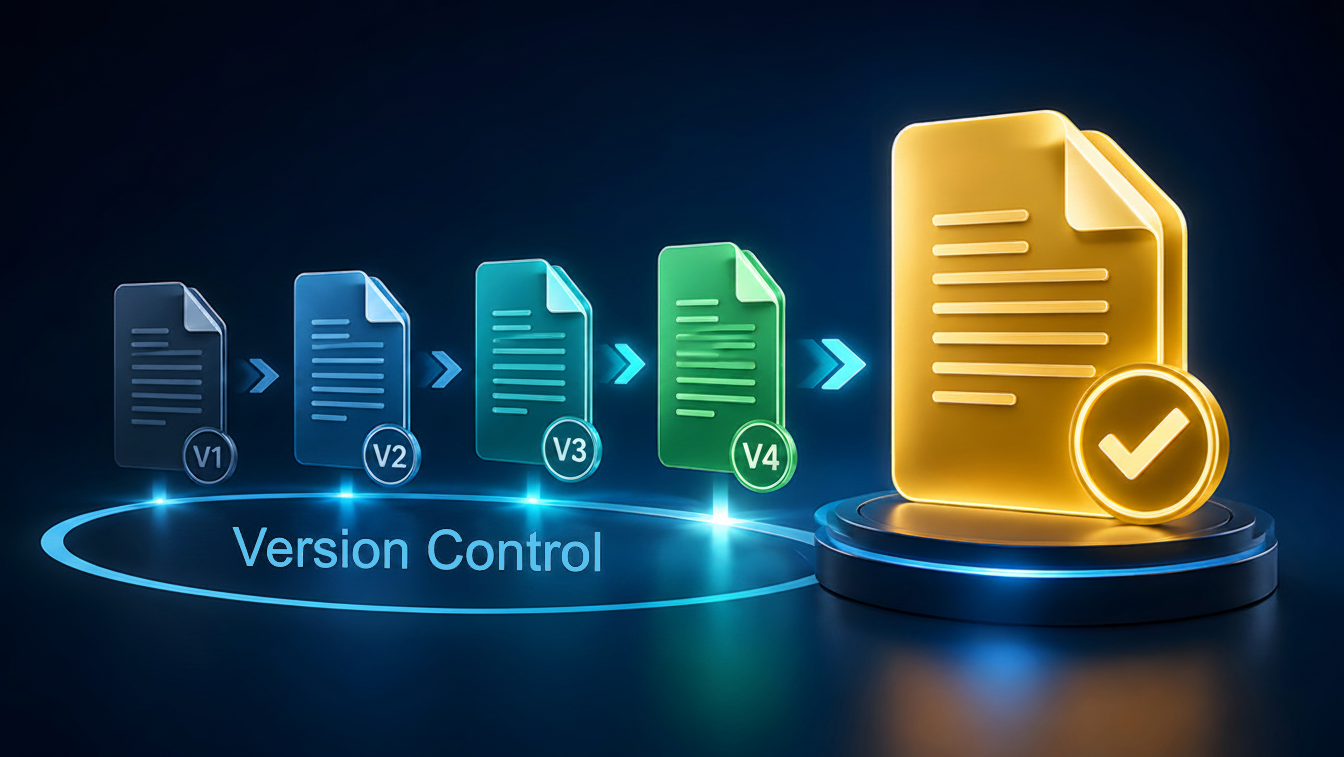
Quick Summary
Version control in clinical trial materials protects research communications from outdated or incorrect content as workflows become more complex. As study materials move through writing, design, regulatory review, translation, printing, publishing, and distribution, even a small source change can affect every downstream asset. Without disciplined version control, teams may submit the wrong version for review, create delays or rework, lose revision traceability, confuse participants or sites, or introduce inconsistencies that may contribute to protocol deviations. A strong version control process keeps teams aligned through clear naming conventions, traceable revisions, defined ownership, controlled distribution, and retirement of obsolete files.
_______________________________________________________
Why Version Control Matters in Clinical Trial Materials
Clinical research demands unwavering precision. All recruitment, referral, educational, and engagement materials, whether participant- or site-facing, must consistently reflect the latest study protocol and approved information at every stage of development and distribution. A critical threat to quality arises not only from inaccuracies, but also from outdated content that continues to circulate after updates are made.
As clinical trial materials move through multiple stakeholders and production stages, effective version control becomes essential for maintaining accuracy, regulatory alignment, and project efficiency. The challenge grows as studies evolve. Protocol amendments, country-specific requirements, ethics committee feedback, and institutional preferences can all trigger updates that must be reflected across a wide range of connected assets.
What is Version Control?
According to the National Institutes of Health (NIH), version control is a critical component of effective document management.1 It is the process of tracking, approving, updating, distributing, and retiring document revisions so every stakeholder works from the current approved source.2 In clinical research communications, version control helps sponsors, CROs, and study team members maintain accuracy across medical writing, design, regulatory review, translation, printing, publishing, and site distribution. A strong version control process supports traceability, reduces rework, and helps protect participant safety when source content changes.
Clinical Research Unique Version Control Challenges & Risks
Version control risk increases as clinical trial material workflows become more complex. These risks can include submitting outdated or incorrect versions for regulatory review, creating delays or rework, increasing avoidable costs, losing revision traceability, confusing participants or sites, and introducing inconsistencies that may contribute to protocol deviations.
Clinical research documents rarely stop after medical writing. Typically, they move through a complex chain of specialized services before reaching investigators or participants.
That complexity makes version control less of an administrative task and more of an operational safeguard. The more handoffs a document passes through, the more important it becomes to know which file is current, who approved it, and which downstream materials need to be updated.
A participant recruitment brochure, for example, might follow this path:
- Medical writing
- Sponsor review and changes
- Graphic design
- Regulatory review
- Print-approved master documents
- Translation into several languages
- In-country review and localization
- Proofreading and formatting
- Digital publishing
- Commercial printing
- Distribution to study sites
At every step, revisions are possible. Imagine that after translations have already begun, the sponsor updates an eligibility criterion or revises safety language. Suddenly, every translated version, every designed layout, every digital file, and every print-ready document must be updated before release.
Without disciplined version control, one team may continue working from an outdated file while another has already incorporated the latest revisions.
Small Version Control Errors Can Create Big Consequences
Version control issues rarely begin as major problems. More often, they start with an overlooked email attachment, a file saved in the wrong folder, or a revision that was not communicated clearly across teams. Each issue requires additional reviews, new approvals, revised translations, reprinting, or redistribution.
These disruptions can increase costs and slow study timelines. They can also create inconsistencies across participant-facing materials, which may reduce comprehension and confidence. In a regulated environment, preventable document confusion can have implications far beyond administrative inconvenience.
Best Practices for Effective Version Control in Clinical Trial Materials

Strong version control is not just about numbering files correctly. It requires governance, process discipline, and role clarity. A standard operating procedure or work instruction should define how teams identify the current approved version, archive retired documents, assign ownership, control distribution, and reconcile downstream materials after source changes.2 The following elements can help guide that process:
1. Use one master source file and assign one accountable owner
Every document should have a clearly identified master source and one owner (person or team) responsible for version integrity across the full workflow. All edits should route through the master source rather than through disconnected copies.
If translated or designed versions are created, they should always map back to the approved source version, and the responsible owner should maintain the master record, coordinate updates, and confirm final alignment.
2. Apply a consistent naming convention
Document names should follow a defined versioning convention that identifies the protocol ID, document type or title, source file reference, applicable country or language codes3, 4, version number, and revision number. This convention should make it easy for teams to recognize the current approved file, trace changes, and distinguish global source updates from country-specific or language-specific revisions.
The naming approach should be documented and applied consistently across the study so teams can understand each file’s relationship to the approved master source without relying on informal labels or disconnected copies.
3. Maintain a documented change history
Maintain a tracker or change log to capture initial approval dates, why a change was made, who approved it, and when it became effective. Archive evidence of what changed (i.e., marked PDF or redlined Word document). This becomes especially valuable when multiple services are involved and when questions arise later during audits or follow-up reviews.
4. Control access and distribution
Not everyone should be able to edit the same file. Teams should limit editing rights, define approval rights, and archive obsolete versions in a way that prevents accidental reuse. Shared folders without access controls can quickly become a source of confusion.
5. Reconcile every downstream asset after source changes
If the source document changes, teams should assess the impact on translations, print files, digital content, labels, and site materials. A formal impact check prevents one updated asset from drifting away from the rest.
6. Reduce handoffs and clarify accountability
When clinical study services are split across multiple parties, each handoff introduces another opportunity for delay, misunderstanding, duplicated files, or version drift. Clear accountability helps ensure changes move quickly and consistently across writing, translation, design, print production, digital publishing, and distribution.
The goal is to reduce unnecessary handoffs, define ownership before revisions begin, and ensure each affected asset can be updated, verified, and traced before materials move forward.
Conclusion
Version control in clinical trial materials helps protect accuracy from initial draft through final distribution. In a workflow shaped by protocol updates, regulatory review, localization, design revisions, and site deployment, disciplined version control supports traceability, efficiency, and participant safety.
For sponsors, CROs, and study team members, the goal is straightforward: make sure every stakeholder works from the current approved source and that every downstream asset reflects that source correctly. When ownership is clear and coordination is strong, version control becomes a practical safeguard for quality across the study lifecycle.
The Imperial Advantage
Imperial performs connected services through one integrated workflow, helping sponsors and CROs maintain version control across clinical trial materials, translation management, print production, digital publishing, and distribution. With related services moving through a unified process, source changes can be reviewed, updated, verified, and advanced with greater control.
For study teams, that means one accountable partner, clearer ownership, fewer disconnects, and greater confidence that the right version is moving forward at each stage. Visit Imperialcrs.com for more information.

FAQ: Version Control in Clinical Trial Materials
What is version control in clinical research?
Version control is the structured process used to manage document revisions from draft through final distribution. It creates a traceable record of updates, approvals, and effective versions so teams can work from the correct file at every stage.
Why is version control important in clinical trial materials?
Clinical trial materials often move through medical writing, sponsor review, design, regulatory review, translation, localization, printing, and digital publishing. Version control helps keep those steps aligned so changes made upstream are reflected in every downstream asset.
What types of clinical trial materials require version control?
Any study communication that may be revised, reviewed, translated, printed, published, or distributed should be version controlled. This can include recruitment materials, informed consent support materials, patient education content, labels, site materials, digital assets, and translated documents.
What happens when outdated study materials are used?
Outdated materials can lead to inconsistent messaging, delayed approvals, rework, avoidable print costs, and increased compliance risk. In participant-facing communications, outdated or incorrect content can also reduce clarity and create confusion for participants or sites.
Who should own version control in a clinical trial workflow?
One person or team should be accountable for version integrity across the workflow. Other contributors may support writing, design, translation, review, or production, but clear ownership helps maintain alignment and traceability.
How should teams handle source changes after translation or design has started?
Teams should review the impact of the source change immediately, identify every affected downstream asset, update the master record, and confirm that revised files replace obsolete versions before release.
References
- National Institute of Dental and Craniofacial Research. Version Control Guidance. National Institutes of Health. https://www.nidcr.nih.gov/sites/default/files/2018-03/version-control-guidance.docx
- World Health Organization. Laboratory Quality Management System: Document Control. https://extranet.who.int/lqsi/sites/default/files/attachedfiles/LQMS%2016-5%20Doc%20control.pdf
- International Organization for Standardization. ISO 3166 Country Codes. https://www.iso.org/iso-3166-country-codes.html
- International Organization for Standardization. ISO 639 Language Code. https://www.iso.org/iso-639-language-code
